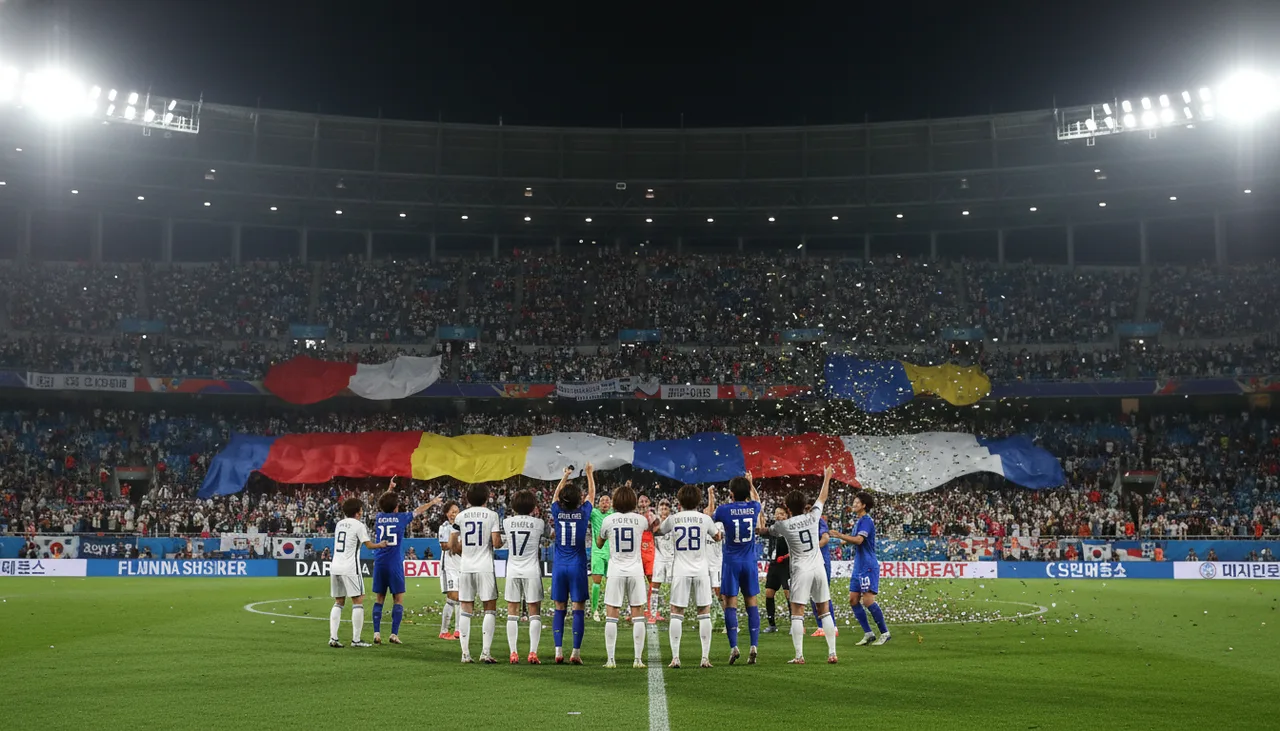
Football has a habit of producing moments that transcend the sport, and Saturday's Asian Women's Champions League final in Suwon delivered one of the most remarkable scenes the game has seen in years. North Korean club Naegohyang defeated Tokyo Verdy Beleza 1-0 to be crowned Asian champions — and they did it on South Korean soil, in a country with which their nation remains technically at war.
A goal that made history
It was captain Kim Kyong Yong who settled the final, finding the net just before half-time with the only goal of the game. That single strike was enough to hand Naegohyang the title in their debut season in the competition — a remarkable achievement for a club founded in 2012 whose name translates simply as "My Hometown".
The final whistle triggered celebrations that carried a meaning far beyond football. Naegohyang's players paraded North Korea's national flag around the stadium, a sight that carries genuine legal weight in South Korea, where the flag is ordinarily banned under the National Security Act. Certain international sporting events are among the narrow exceptions that permit its display, and Saturday's final clearly qualified.
The politics behind the fixture
The very fact that Naegohyang were present in Suwon at all was historic. Inter-Korean relations have deteriorated sharply in recent years — North Korea has publicly labelled its southern neighbour its "most hostile state" and stated it no longer seeks reunification. The two countries have not signed a peace treaty since the Korean War concluded in 1953.
Given that backdrop, there were no away supporters inside the ground, with travel restrictions between the two states making that impossible. Instead, around 1,200 members of civic groups backed by Seoul's unification ministry attended to lend the occasion some atmosphere. South Korea's Unification Minister Chund Dong-young had said ahead of the semi-final that the tournament could set a "positive precedent" for inter-Korean relations, and South Korean President Lee Jae Myung has made improving ties a stated priority.
Whether football can genuinely soften one of the world's most intractable political divisions remains deeply uncertain. But the sight of a North Korean squad competing — and winning — in the South was something many observers considered unthinkable only months ago.
Coach deflects political questions
Naegohyang head coach Ri Yu Il was understandably emotional after the final whistle, describing the victory as a "historic moment" and speaking of emotions that were "simply indescribable". However, the post-match news conference took an awkward turn when a South Korean journalist asked a question that referred to North Korea as the "north side" — a phrasing that Ri and Kim Kyong Yong apparently found unacceptable. Both walked out of the room.
"All of our players focused solely on winning today's match, putting in the effort while cherishing every minute and second," Ri said before departing. "I did not have the time or room to concern myself with various other issues."
What comes next
Victory in Suwon has tangible sporting consequences. Naegohyang have qualified for next year's FIFA Women's Champions Cup, the competition that pits the champions of each of the six continental confederations against one another. It will represent yet another first for North Korean women's football on the global stage.
For the women's game more broadly, the final served as a reminder of just how far the Asian game has developed — and of football's occasional, stubborn ability to push through borders that politics has spent decades reinforcing.
Frequently asked
- Who are Naegohyang and where are they from?
- Naegohyang are a women's football club from North Korea, founded in 2012. Their name means "My Hometown" in Korean. They won the Asian Women's Champions League in their very first season in the competition.
- Why was it historic for a North Korean team to play in South Korea?
- The two Koreas have been technically at war since the 1950s and have not signed a peace treaty. North Korea has in recent years described South Korea as its most hostile state, making cross-border sporting visits extremely rare and politically significant.
- What tournament do Naegohyang qualify for after winning the Asian Women's Champions League?
- Their victory earns them a place at the FIFA Women's Champions Cup, which brings together the champions from each of the six continental confederations.