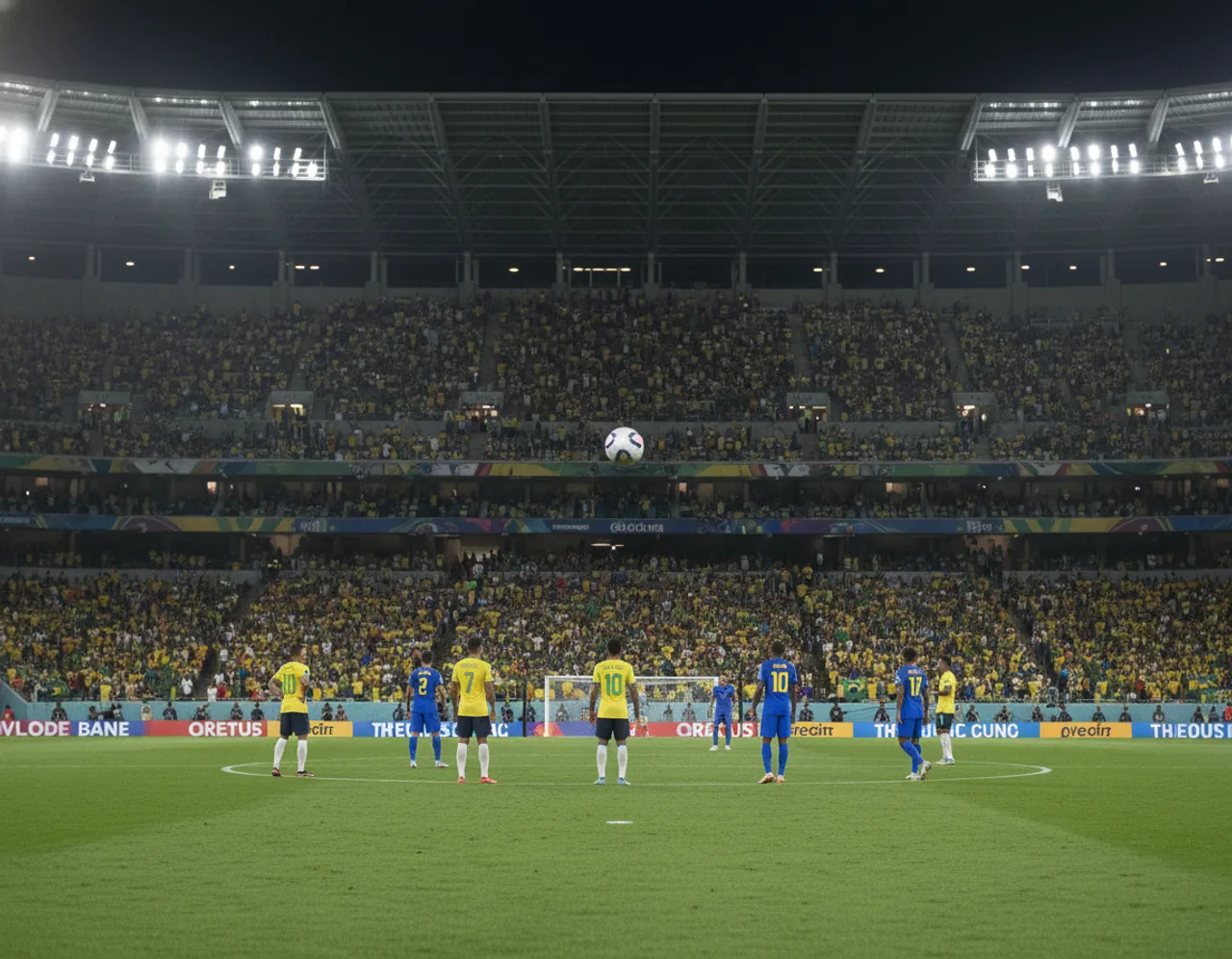
There is a particular kind of hope that outlasts the evidence. Carlo Ancelotti, a man who has won the Champions League more times than any other manager, has included Neymar in his Brazil squad for the 2026 World Cup. It is a selection that says as much about what Brazil needs to believe as it does about the 34-year-old's current condition.
The comparison with Lionel Messi at the 2022 World Cup in Qatar is already being made, and Ancelotti's decision appears, at least in part, to be an attempt to conjure a similar narrative — a fading great seizing one last chance at the game's ultimate prize. Messi was 35 when he lifted the trophy in Lusail; Neymar is 34. Beyond the numbers, however, the parallels thin considerably.
A shadow that never lifted
When Neymar made his Brazil debut at 18, following the disappointment of the 2010 World Cup in South Africa, the country's football establishment was already framing him as their answer to a question Argentina had already answered. Messi was 23 at the time, a player of unmistakable brilliance, and Brazil, with their incomparable history, felt they required an equivalent. That framing — well-intentioned but ultimately suffocating — shaped everything that followed.
The culture of dependency it created served no one well, least of all Neymar himself. He became a vessel into which competing factions poured their own narratives, and the actual footballer was sometimes obscured in the process. His substance rarely matched the image the country had constructed around him, and that gap was never truly his making.
There is a genuine poignancy in that story. After Brazil's quarter-final defeat by Belgium at the 2018 World Cup in Russia, Neymar was photographed standing alone in the stadium car park in Kazan, silhouetted against a large LED screen, his shoulders carrying the full weight of a nation's disappointment. He was 26. Even then, it felt as though his best opportunity had passed.
The tactical cost of adulation
Belgium's Roberto Martínez had identified the structural weakness that Neymar's inclusion created. By moving Romelu Lukaku wide to the right, Belgium were able to exploit the space on Brazil's left flank every time they won the ball back. The midfield adjustments required to accommodate Neymar left a gap that Brazil, lacking the kind of industrious linking player Argentina had in Rodrigo De Paul, were unable to fill. The result was a 2-1 defeat that felt, in retrospect, entirely avoidable.
That vulnerability had been apparent long before Russia. At the 2011 Copa América, Neymar arrived on a wave of expectation, only for opponents to realise early that his relationship with physical confrontation was complicated. Defenders began targeting him; Neymar began anticipating contact. For most of the following decade, the cycle of provocation and simulation was one of football's most wearying subplots.
In the 2014 World Cup quarter-final against Colombia, that physical toll reached its worst point when a knee in the back from Juan Camilo Zúñiga left Neymar with a fractured vertebra. Brazil beat Colombia but lost their talisman, and then lost, catastrophically, to Germany in the semi-final. The morning after Zúñiga's challenge, Rio de Janeiro was said to have fallen into an almost funereal quiet. The country had tied its hopes so completely to one player that his absence felt like something far greater than a sporting setback.
A familiar act, different circumstances
The market has its own view of what Neymar can contribute in 2026, though the football argument for his inclusion rests on faith as much as form. Ancelotti is not a man given to sentimental selections — his record speaks to a clear-eyed pragmatism — but even the most successful coach in Champions League history cannot entirely escape the political weight that comes with managing Brazil.
The real question is not whether Neymar deserves his place on merit. It is whether a country that has spent fifteen years searching for its own Messi can finally allow itself to look elsewhere — and whether, if the answer is no, Ancelotti has the will to resist that pressure on the touchline when it matters most.
Frequently asked
- Why has Ancelotti picked Neymar for the 2026 World Cup?
- Carlo Ancelotti has included Neymar in Brazil's World Cup squad despite concerns over the 34-year-old's fitness and recent form. The selection appears partly driven by the desire to have a marquee attacking player capable of producing moments of individual quality, as well as the significant public and political pressure that surrounds Neymar's place in the national setup.
- Is Neymar fit for the 2026 World Cup?
- Neymar's fitness has been a persistent concern over recent years. His inclusion in Ancelotti's squad has been described as a gamble, suggesting he is not at full fitness or peak form. Whether he can play a significant role in the tournament remains to be seen.
- How does Brazil's Neymar compare to Argentina's Messi at the World Cup?
- Comparisons between the two have followed Neymar since he broke into the Brazil squad at 18. Messi won the World Cup with Argentina in 2022 at the age of 35, inspiring talk of a 'last dance' narrative. Neymar is 34 ahead of the 2026 tournament, but he has never won a World Cup, and his career has been shaped by injury, expectation and the burden of being cast as Brazil's answer to Messi.