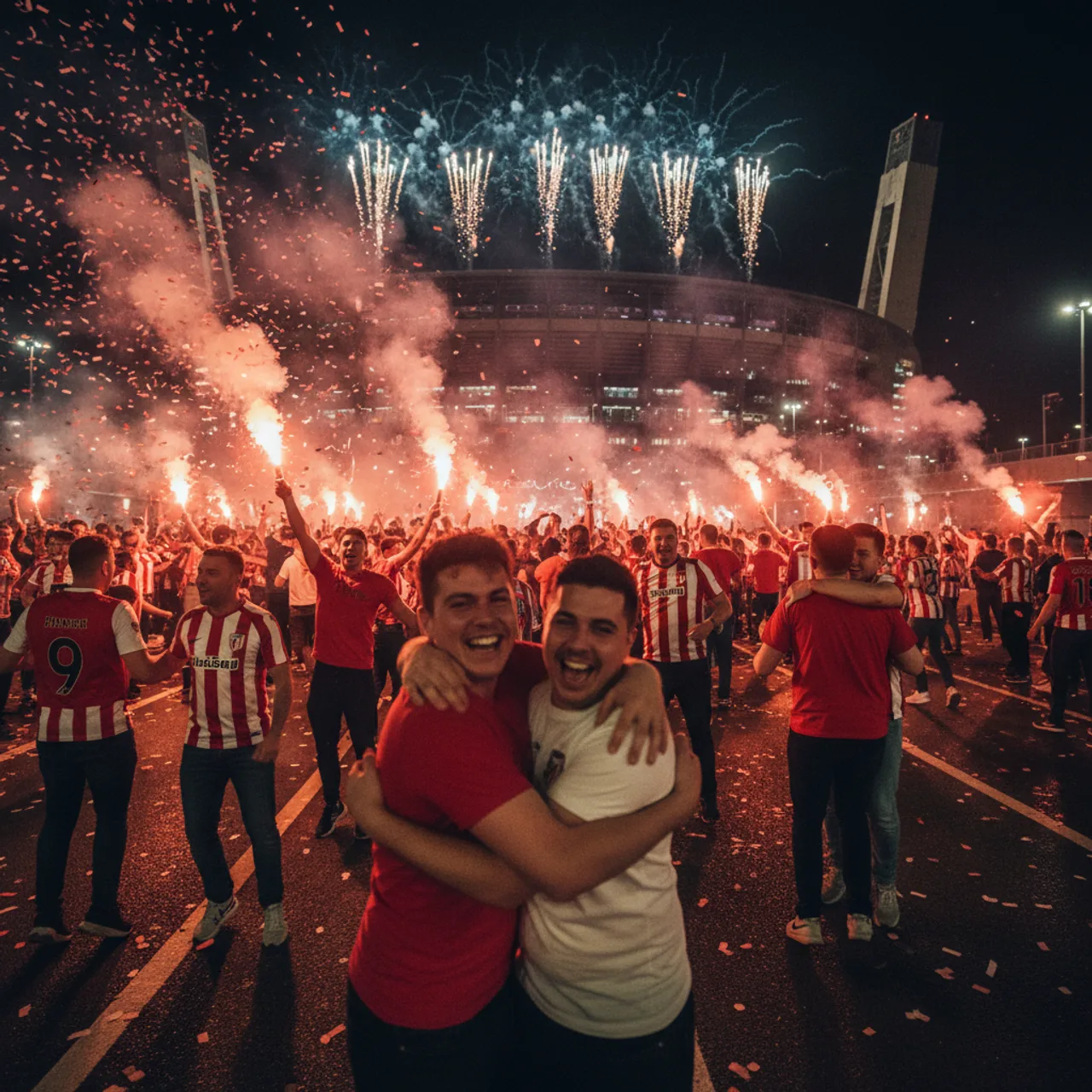
There is a particular kind of night that north London does better than anywhere else. Cool air, amber streetlight bleeding across the terraced houses of Hornsey Road, and the low, building rumble of something that feels almost too large to believe. That was the night Arsenal fans got on Sunday — or rather, the night that found them.
Twenty-two years. That is the gap between Arsenal's last Premier League title and the one they have just claimed. Long enough for a child to be born, grow up, go through school, start a job, and spend their entire adult sporting life watching the club fall just short. Long enough for it to start to feel like a permanent condition rather than a temporary wait.
So when the final whistle came, the people moved instinctively, as people do when something breaks open inside them. They came down Gillespie Road and Benwell Road, past the Plimsoll pub, past the detritus piling up outside Finsbury Park station as though tipped there by some newly appeased god. Perfect strangers grabbed each other by the shoulders. Fireworks went up. People FaceTimed relatives who were crying in living rooms elsewhere. The crowd grew from hundreds into thousands, a lawless, euphoric mass in which all the usual barriers between supporter and supporter — membership tier, seat location, whether you were there for the Invincibles or only for the Arteta era — simply dissolved.
More Than Just a Football Club
Part of what makes Arsenal interesting as a cultural object is how genuinely hard it is to pin down. The tube station is named after them rather than any locality, rebranded in the 1930s at Herbert Chapman's request. The fanbase stretches from Islington to south London to Indore to Ithaca. Most of the playing squad and coaching staff live out in the Hertfordshire commuter belt. It is a club that shares its city with half a dozen other well-supported sides, several of which actively despise it.
And yet the idea of Arsenal — what you might loosely call Arsenalism — has always reflected a particular idea of London itself. The city as a place of constant reinvention, where layers are added and shed, where the outsider can become the local, where the local can feel like a stranger by Wednesday. Metropolitan swagger and metropolitan angst, side by side. The club of Thierry Henry and Tony Adams. Liam Brady and Katie McCabe. Declan Rice and Pat Rice. Different eras, different styles, the same unmistakable identity underneath.
A City That Sometimes Forgets Itself
That identity has felt harder to hold onto in recent years, and not just in football terms. Money has reshaped large swathes of London in ways that leave long-standing residents feeling like guests in their own neighbourhoods. Islington — the borough that wraps around the Emirates — is a place where every state primary school is reportedly operating under capacity, with two having closed last summer alone. The luxury flats go up; the familiar cafes go under; the people who have lived somewhere for decades quietly leave.
It is against that backdrop that the scenes outside the Emirates felt like something worth noting. Not a curated parade or a ticketed event, but an unplanned, genuinely communal outpouring — the market segments, as one observer put it, dissolving into a single human mass. People checking whether everybody else was feeling what they were feeling, communion as a form of confirmation.
The Weight of the Wait
Arsenal have come agonisingly close in recent seasons, carrying the expectation and then the heartbreak in a way that began to feel definitional. Mikel Arteta has shaped a squad with genuine personality — pressing, direct, capable of both controlled possession and explosive transition — and the squad has repaid him with the title his tenure has been building towards.
But the players and the manager will have their moments. Sunday night belonged to the people on the streets, bound together by memory and the sudden, giddy relief of a very long wait finally ending. Somewhere near Hornsey Road, a firework went up and lit the sky briefly orange, and the crowd roared like it was the most natural thing in the world. After 22 years, perhaps it was.
Frequently asked
- How long had Arsenal waited for the Premier League title?
- Arsenal's 2025-26 Premier League title ended a wait of 22 years since their last top-flight championship.
- Where did Arsenal fans celebrate the title win?
- Thousands of supporters gathered around the Emirates Stadium and the surrounding streets of north London, including areas near Finsbury Park station, deep into the night.
- Who is Mikel Arteta and why is he important to Arsenal?
- Mikel Arteta is Arsenal's manager, who has built the side that finally ended the club's long wait for Premier League glory. He was reportedly at home in his garden when the title was confirmed.