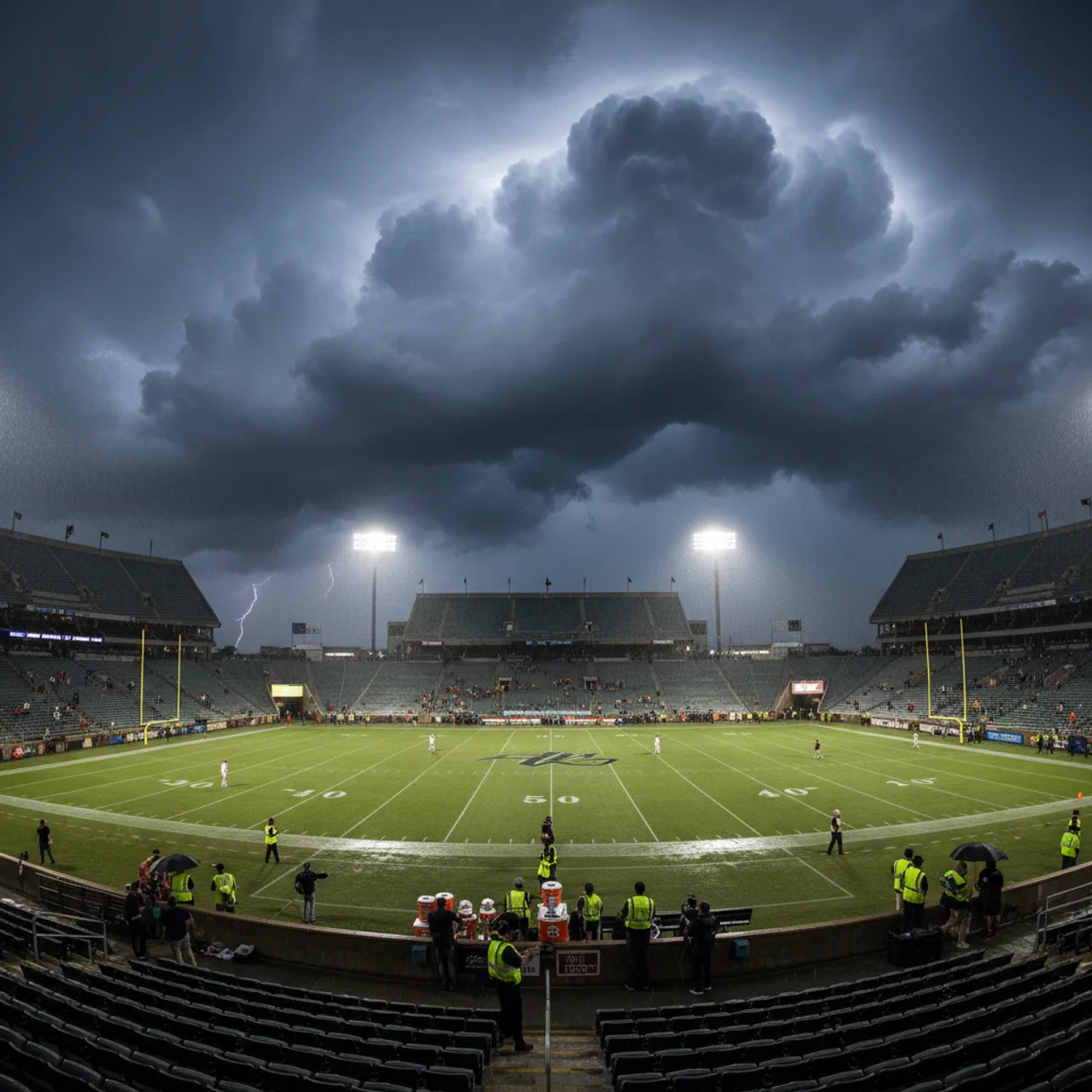
Saudi Arabia's final preparations for the 2026 World Cup hit an unexpected obstacle on Tuesday when their warm-up match against Puerto Rico in Austin, Texas was halted for nearly two hours after a severe thunderstorm rolled over the Q2 Stadium.
The game was stopped in the 21st minute as lightning forced the players off the pitch. Messages were broadcast to supporters inside the ground urging them to seek shelter as the storm intensified. Saudi Arabia eventually ran out 3-0 winners once play resumed, but the incident raised fresh questions about the practicalities of staging a major international tournament in the United States during peak storm season.
How the lightning protocol works
FIFA has a clear policy for dealing with electrical storms. If a lightning strike is detected within eight miles of a venue, play is immediately suspended and a mandatory 30-minute countdown clock begins. Crucially, every subsequent strike within that radius resets the countdown to zero — meaning a persistent storm can extend a delay almost indefinitely.
That is precisely what happened in Austin on Tuesday. A series of strikes kept resetting the clock, stretching what might have been a brief interruption into a nearly two-hour stoppage before conditions finally cleared.
This is not an isolated concern. When the Club World Cup was held in the United States last year, Chelsea's last-16 tie against Benfica in Charlotte lasted four hours and 39 minutes in total, one of several matches significantly disrupted by summer thunderstorms.
Texas venues at the heart of England's World Cup
Whilst the Q2 Stadium in Austin will not host any World Cup matches, two Texas grounds are central to the tournament. Houston's stadium will stage seven fixtures, and Dallas's venue will host nine — including England's group-stage meeting with Croatia, one of the most eagerly anticipated ties for fans back home.
The disruption in Austin is therefore more than a curiosity; it is a practical rehearsal for the kind of weather scenarios that could affect England and every other competing nation. Tournament organisers will be closely monitoring how delays are managed and communicated, particularly given the scale of the event and the distances fans will have travelled.
Heat as well as storms
Lightning is not the only weather-related concern hanging over the tournament, which begins on 11 June. Researchers have warned that temperatures at 14 of the 16 stadiums scheduled to be used could reach levels considered dangerous for players and supporters alike. With the competition running through June and into July, both heat and thunderstorms are likely to be recurring factors throughout.
Saudi Arabia's road to the group stage
Despite the disruption, Saudi Arabia completed their preparation in positive fashion. They face Senegal in their final warm-up on Wednesday before their World Cup campaign opens against Uruguay at the Miami Stadium on 15 June. Further Group H fixtures follow against Spain in Atlanta on 21 June and Cape Verde in Houston on 27 June — a venue where the lightning protocol may well come into play again.
For now, the result is a footnote. But the two-hour delay in Austin is a timely reminder that the weather in the southern United States in early summer is an unpredictable opponent that no amount of tactical preparation can fully account for.
Frequently asked
- Why was the Saudi Arabia vs Puerto Rico game stopped in Texas?
- The match was halted in the 21st minute because of a severe thunderstorm. Under FIFA's lightning protocol, play must be suspended when a strike is detected within eight miles of the stadium, with a 30-minute countdown that resets every time another strike occurs in that zone.
- Which World Cup 2026 matches are being played in Texas?
- Houston's stadium will host seven matches and the Dallas stadium will host nine, including England's group-stage game against Croatia. The Q2 Stadium in Austin, where Tuesday's warm-up was played, is not a World Cup venue.
- Could thunderstorms disrupt matches at the 2026 World Cup?
- Yes, it is a genuine concern. The tournament runs from 11 June during peak thunderstorm season in several host cities. FIFA's rules require play to stop when lightning is detected within eight miles, and last year's Club World Cup in the US saw multiple matches significantly delayed by summer storms.