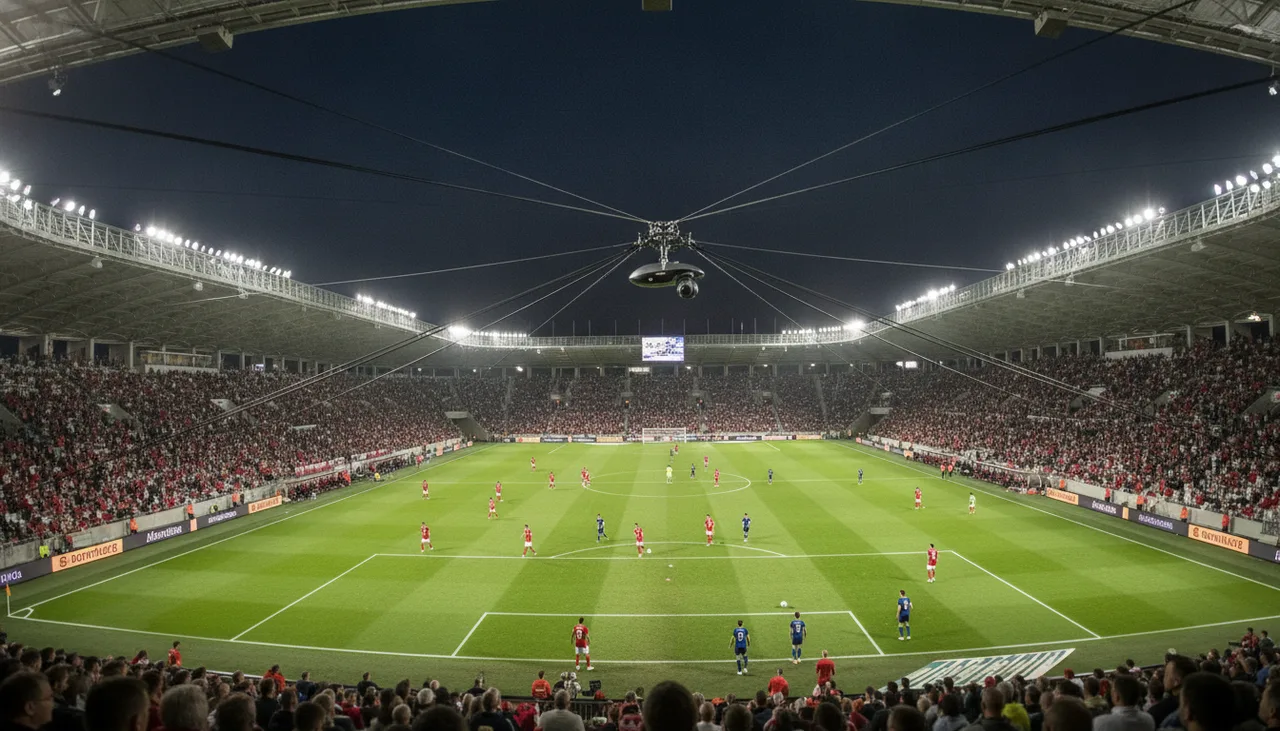
Football has witnessed some unusual interruptions over the years, but few quite as alarming as the incident that brought Hungary's friendly against Kazakhstan to a temporary halt in Debrecen on Tuesday. A spidercam — the type of camera suspended on wires above the playing surface and commonplace at major sporting events — fell from a height of more than 20 metres and landed just inside the touchline, two metres from a cameraman who was fortunate to escape unharmed.
According to Hungarian media, the drama unfolded midway through the first half when fire damaged the cable holding the camera aloft. The device reportedly began to smoke before the cable finally gave way, sending it crashing down near Hungary's warm-up area at Nagyerdei Stadium. Nobody was injured in the incident, a detail that will bring considerable relief to the organisers once the initial shock subsides.
Referee and players alike took a drinks break in the 26th minute while officials dealt with the stricken equipment and ensured the area was safe. It was, by all accounts, a composed response to what could, in different circumstances, have been a serious incident. The fact that the landing zone was on the periphery of the pitch rather than in the thick of play was fortunate in the extreme.
Hungary take the points despite the disruption
Once order was restored, the match continued and Hungary showed no lasting ill-effects from the commotion. They ran out 3-1 winners against Kazakhstan, a result that will please the home supporters and management alike. Liverpool midfielder Dominik Szoboszlai was among the scorers, further underlining his importance to the national side ahead of what promises to be a busy international calendar.
The result was almost a footnote to the wider conversation, however. Incidents of this nature shine a light on the infrastructure demands of modern broadcast football. Spidercam systems are valued for the dynamic, bird's-eye footage they provide, but they introduce a degree of mechanical complexity — motors, cables, tension systems — that requires rigorous maintenance and safety oversight. When something goes wrong at height, the consequences can be severe.
A timely reminder about broadcast safety protocols
Nagyerdei Stadium in Debrecen holds just over 20,000 spectators and has hosted international fixtures for Hungary on a number of occasions. The venue itself is not under scrutiny here — equipment failure of this kind can occur at any ground — but the incident will undoubtedly prompt broadcasters and football authorities to revisit their safety checklists for aerial camera systems.
There will be questions asked in the coming days about how the cable came to catch fire in the first place and whether inspection routines were followed to the letter. Those are reasonable questions, and the answers will matter to anyone responsible for staging televised football at any level.
For now, the overriding emotion is one of relief. A camera fell more than 20 metres onto a football pitch during a live international match, and not a single person was hurt. That is, by any measure, an outcome that could have been very different indeed. Hungary and Kazakhstan will move on; the wider game would do well to take note.
Frequently asked
- What is a spidercam in football?
- A spidercam is a camera suspended above the pitch by a network of wires and motorised cables. It can move horizontally and vertically to capture aerial footage during matches and is commonly used in broadcast coverage of football and other sports.
- Was anyone hurt when the camera fell during the Hungary game?
- No. The camera landed just inside the touchline, approximately two metres from a cameraman, but nobody was injured. Play was briefly halted in the 26th minute while the incident was dealt with.
- What was the final score in Hungary vs Kazakhstan?
- Hungary won the friendly 3-1 against Kazakhstan at Nagyerdei Stadium in Debrecen. Liverpool midfielder Dominik Szoboszlai was among the goalscorers for the home side.